






Can Physical Therapy in Davie Help After an ACL Tear?
Tear your ACL and suddenly everything changes. That popping sound, the immediate instability, the swelling that shows up fast and stays longer than you'd like. Most people assume surgery is the only answer. But the reality is more nuanced than that — and physical therapy sits right at the center of your recovery, whether you go under the knife or not.
We're not talking about generic stretches or passive treatments. Real rehabilitation after an ACL injury demands structure, precision, and a clear understanding of what your knee needs to heal properly. Skip that foundation and you're setting yourself up for chronic instability, compensatory pain, or another injury down the line. The ligament might be damaged, but the path forward depends entirely on how you rebuild around it.
What Actually Happens When the ACL Goes
The anterior cruciate ligament doesn't just tear during dramatic collisions. It ruptures when your knee twists under load, when you plant and pivot awkwardly, when deceleration meets poor mechanics. Athletes see it most — basketball players changing direction, soccer players cutting hard, skiers catching an edge. But weekend warriors get caught too, especially when fatigue sets in and form breaks down.
Once it's torn, your knee loses its primary stabilizer. You'll feel the joint give out, struggle to bear weight, and deal with swelling that makes even simple movements uncomfortable. Some tears are partial and leave residual function. Others are complete ruptures that leave the knee almost useless without intervention. Either way, what happens next determines whether you regain full function or spend years compensating for weakness.
Surgery Isn't Always the First Move
Plenty of people assume a torn ACL means immediate reconstruction. But that's not automatic. Age, activity level, and the severity of the tear all factor into the decision. Older adults with lower activity demands might skip surgery entirely and rely on strengthening protocols. Younger athletes with complete tears and high return-to-sport goals usually need reconstruction to restore stability.
What doesn't change? Physical therapy is mandatory either way. If you're having surgery, rehab starts before the procedure and continues for months afterward. If you're going the conservative route, therapy becomes the primary treatment — not a backup plan. You can't just rest your way back to normal. The muscles, proprioception, and movement patterns all need deliberate rebuilding.
Early Stage Recovery Focuses on Control
Right after the injury, the knee is angry. Swelling limits motion, pain discourages movement, and instability makes you hesitant to load the joint. Early-stage therapy tackles all of that with targeted interventions that don't push too hard too soon.
- Ice, compression, and elevation bring down inflammation without masking the underlying issue
- Gentle range-of-motion exercises prevent stiffness from locking in while tissues heal
- Quad activation drills fight the reflex inhibition that shuts down muscle firing after trauma
- Weight-bearing progressions teach the joint to handle load again without buckling
- Gait training corrects limping patterns before they become ingrained habits
This phase isn't glamorous. Progress feels slow. But skipping these steps or rushing through them creates problems that surface months later when you try to return to real activity.
Strength Work Builds the Foundation
Once swelling drops and motion improves, the focus shifts to rebuilding what the injury took away. The quadriceps and hamstrings weaken fast after an ACL tear — sometimes losing significant strength within days. That muscle loss doesn't come back on its own, and weakness leaves the knee vulnerable even after the ligament heals or gets reconstructed.
Therapists design progressive loading protocols that start with isolated exercises and advance toward functional movements. You're not just doing leg presses for the sake of it. Every exercise targets a specific deficit, whether that's quad strength, hamstring endurance, or glute activation. The goal is symmetry — matching the injured side to the healthy one so you're not compensating with one leg doing all the work.
Balance and Proprioception Get Rebuilt From Scratch
Losing an ACL doesn't just mean losing stability. It means losing your knee's ability to sense where it is in space. Proprioception — the body's internal GPS for joint position — gets disrupted when the ligament tears. That's why people with ACL injuries feel unsteady even after strength returns.
- Single-leg balance drills retrain the nervous system to stabilize without visual feedback
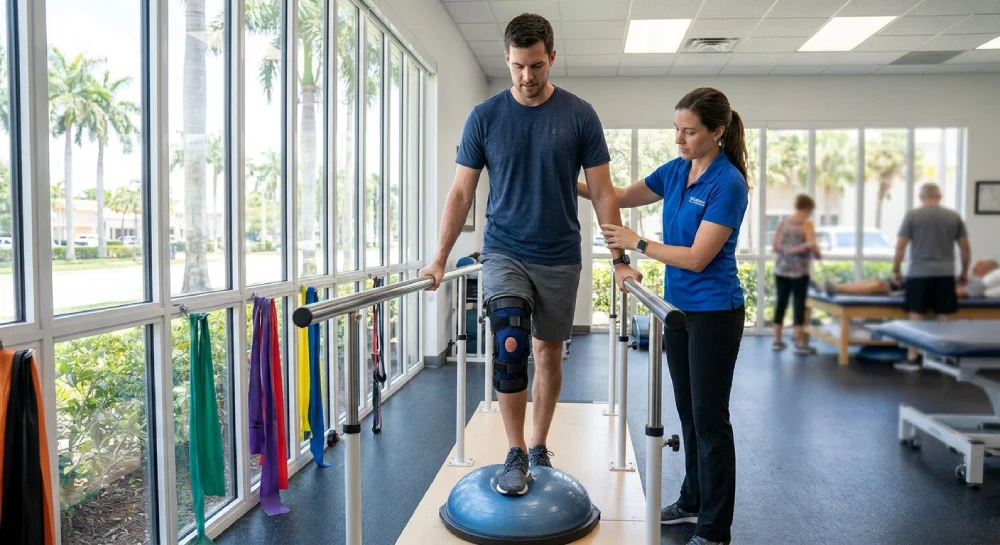
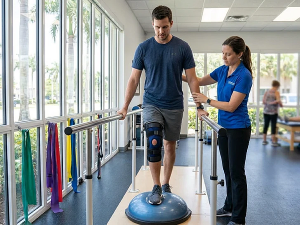
- Wobble board and BOSU exercises challenge dynamic control under unstable conditions
- Plyometric progressions teach the knee to absorb and redirect force safely
- Agility drills reintroduce cutting, pivoting, and lateral movement without overloading the joint
- Sport-specific movements prepare athletes to handle the exact demands they'll face in competition
This phase separates those who return to full function from those who stay cautious forever. You can have strong muscles and full motion, but if proprioception isn't restored, the knee will give out when you need it most.
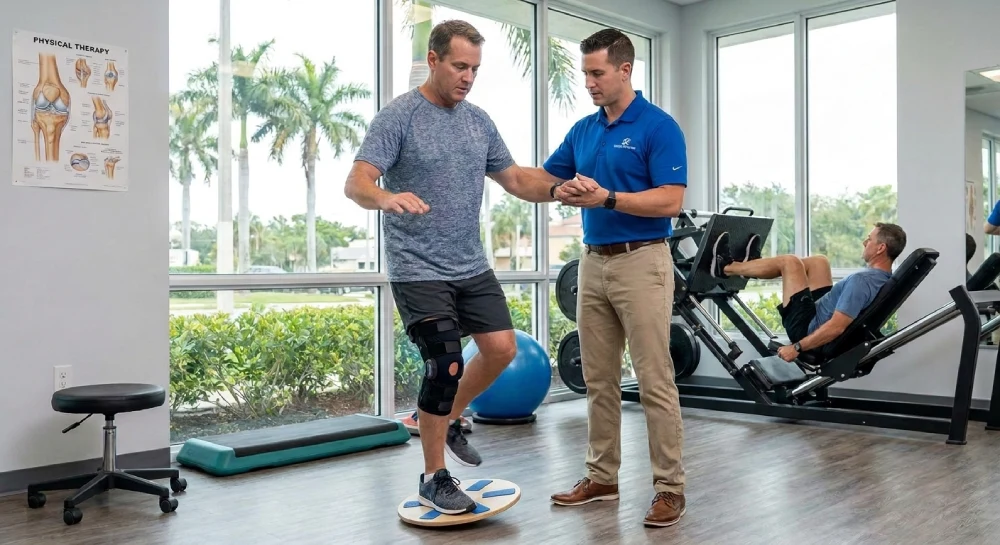
Post-Surgical Rehab Follows a Clear Timeline
If you opt for ACL reconstruction, the post-surgical rehabilitation protocol becomes more structured. Surgery gives you a new ligament, but that graft needs time to integrate and mature. Push too hard too early and you risk rupturing the graft. Move too slowly and you lose motion, develop scar tissue, or end up with chronic stiffness.
Most protocols break recovery into phases. Early weeks focus on controlling swelling and restoring extension. Mid-stage rehab emphasizes strength and neuromuscular control. Late-stage work introduces plyometrics, cutting, and ACL injury prevention criteria. Progression depends on hitting specific benchmarks — not just time elapsed. We don't clear athletes for return based on a calendar. We clear them when strength, stability, and confidence meet objective standards.
Conservative Management Demands Just as Much Effort
Choosing not to have surgery doesn't mean taking the easy road. If anything, non-surgical ACL management requires even more discipline. Without a reconstructed ligament, the knee relies entirely on muscular stability and movement control to compensate for the loss.
- Strengthening protocols target the quads, hamstrings, and glutes to create dynamic stability
- Bracing or taping provides external support during high-demand activities
- Activity modification teaches patients which movements are safe and which risk further damage
- Ongoing monitoring ensures that compensatory patterns don't lead to secondary injuries
- Long-term maintenance programs keep the knee functional as demands change over time
Some people do well with this approach, especially if they're willing to adjust their activity level. Others eventually opt for surgery after realizing that conservative management limits what they can do. There's no shame in either choice — just clarity about what each path requires.
Finding the Right Therapist Makes the Difference
Not all physical therapy is created equal. ACL rehab requires expertise in orthopedic and sports medicine, not just general mobility work. We've seen too many patients go through months of generic exercises without addressing the specific deficits that matter most for knee stability.
- Look for clinics with experience treating ACL injuries specifically, not just knee pain in general
- Ask about their protocol progression and how they track objective progress markers
- Make sure they communicate directly with your surgeon if you've had reconstruction
- Check that they incorporate functional and sport-specific training, not just gym exercises
- Verify that they're willing to adjust the plan based on how your body responds, not just follow a template
The therapist you choose becomes your partner for months. You want someone who understands the science, respects the timeline, and pushes you appropriately without recklessness.
Rehabilitation Isn't Optional for Long-Term Function
ACL tears don't heal themselves into full stability. Surgery can restore the ligament, but it can't restore strength, balance, or movement quality. Conservative management can maintain function, but only if the surrounding structures compensate effectively. Either way, knee pain relief and recovery require what bridges the gap between injury and return to activity.
We work with patients in Davie who want more than just pain relief. They want to get back on the field, return to the gym, or simply walk without hesitation. That requires commitment, consistency, and a clear understanding that recovery doesn't end when pain fades. It ends when the knee can handle everything you ask of it — safely, confidently, and without compromise. Anything less leaves you vulnerable to another injury or years of limitations you didn't sign up for.
Let's Get You Moving Again
Recovering from an ACL tear is a journey, but you don’t have to navigate it alone. Together, we can build a plan that gets you back to the activities you love with confidence and strength. If you’re ready to take the next step, give us a call at 954-474-3611 or request an appointment and let’s start your recovery the right way.
‹ Back
Recent Posts
-
Shockwave Therapy in Knoxville for Chronic Prostatitis
September 16, 2026
-
Can Physical Therapy in North Miami Beach Ease Neck Pain From Sports?
September 2, 2026
-
-
Can Physical Therapy in Davie Help After an ACL Tear?
August 5, 2026
-